
Premised upon my last three columns on patriotism, a small debate ensued on Facebook about whom or what defines good or great leadership. This column is my response to that query, but I would like to address it from a perspective of an RMC Old Putera, the alumni of the Royal Military College (RMC); our alma mater.
All Old Puteras were trained to ‘Serve to Lead’, or ‘Berkhidmat Memimpin’. The unasked question is who then do we serve and lead? Every Saturday, at the parade square, we actually saluted the flag of the federation, what is now called the ‘Jalur Gemilang’. Therein lay the answer as to whom we were called and taught to serve or seek to lead.
From good to great
Many books have been written about the two words ‘good versus great’. ‘Good to Great’ by Jim Collins is one very popular one. In the nineties, ‘Built to Last’ was published about great companies with good work ethics and a mature performance culture. But the question remained, what about the company which is not born with a great DNA? How can good companies, mediocre companies, even bad companies achieve enduring greatness?
“For years, this question preyed on the mind of Jim Collins. Are there companies that defy gravity and convert long-term mediocrity or worse into long-term superiority? And if so, what are the universal distinguishing characteristics that cause a company to go from good to great?”
I can fully understand why most authors, writers, and scholars shy away from the word, ‘good’. When a Nicodemus, a teacher of the laws of Israel, approached Jesus and asked the question by night, “Good Teacher, how do I inherit eternal life?” Jesus responded with another question: “Why do you call me good; only God is good”.
Therefore, for human systems or organisations like companies or countries, it is easier to talk about being great places for good to great experiences. In fact, Robert Levering, another researcher, as a sequel to ‘In Search of Excellence’ by Peters and Waterman, wrote ‘A Great Place to Work’:
“Good workplaces are worth examining if for no other reason than that they enrich the lives of the people working there. Everyone, after all, would prefer working in a pleasant environment to an unpleasant one. Since most of us spend the greater part of our waking hours at work, this is no small matter.”
Great leadership in Malaysia
What would great leadership in Malaysia look like? Would it just be, “I did it My Way?” which appears to be Donald Trump and Rodrigo Duterte’s favourite song? Or, is it our Malaysian way of ‘close one eye culture’ of ‘nasi campur’ – all and sundry meshed together on the same plate, but very delicious to the stomach and human desires? While palatable, it may not be good either for health or body?
What is the kind and quality of good leadership for Malaysia; of the ‘Serve to Lead’ kind? To answer this question, first we need to define the units of analysis to peg the problem definition at its core and essence.
Malaysia is a federation
Any federation is a coming together, a willing one, of many parts to make a whole greater than the sum of its parts. That means the whole federation is a unit of analysis greater that all its parts. We are not a confederation either. A confederation is the coming together of small groups of constituent sub-wholes to make a greater whole. The European Union (EU) is more like a confederation.
For example the Federation of Malaysian Manufacturers is a confederation of many industry associations and they come together as a greater whole to dialogue and take concerns with the government or any other party.
Neither are we a unitary state like the Philippines or Indonesia. They have no states with legal existence; except for the newly-created autonomous zones of Aceh, or the Muslim South areas of Mindanao. In Indonesia, post the tsunami, Aceh was made an autonomous zone because of the unique problems they faced.
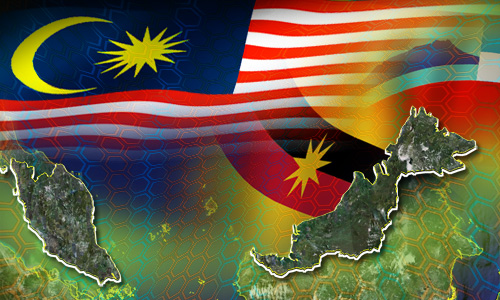
Malaysia is a therefore a federation of three constituent parts; of the two Borneo States, and the Federation of Malay States. Our whole is greater but the sum of the parts is not 13 or 14; whichever way we argue it, but rather three constituent parts, since Singapore left in 1965.
Parliamentary and constitutional democracy
While nine feudal Malay kingdoms came together to make the Federation of Malaya with two Straits Settlements in 1957, our system of governance was designed, developed, and crafted to become a constitutional democracy. The Parliament defines our laws; both in letter and spirit.
Then, in 1963, when the new Borneo States with Singapore came together to make or form the bigger reality called Malaysia; it was not merely a linear projection of the Merdeka Democracy. It really is an improvement of our parliamentary and constitutional democracy of the four, and later, three states to become a brand new whole greater than the sum of its three parts.
The Federal Constitution is the Supreme Law of the Federation, and it defines all else, including the structure, format, and principles of how our democracy is to be framed, shaped, and continue to be improved.
Anything that detracts from the supremacy of this Federal Constitution, including new developments through the specific interpretation of a Wahhabi form of Islam, or a Shiite-Sufi Islam cannot be included simply because of the tyranny of a majority. The constitution reigns supreme.
Constitutional monarchy
This past week we had the meeting of the Rulers-in-Council; these include all nine Malay State Rulers, plus politically appointed ‘Malay’ governors, or the other four legitimate entities and their respective politically elected heads of state. All such meetings and protocols are well enshrined protocols within the constitution.
What is not well enshrined by the Federal Constitution can be considered as traditional Malay customs or culture from their historic system of feudal governance of these nine respective states.
Great leadership is only when all community leaders of Malaysia, whether appointed, elected, or voluntary choose to put nation-state interests above their own and ‘Serve to Lead’ our nation out of the current quagmire. May God continue to forgive our ignorance and arrogance.
(This column is dedicated as my prayer for the future of the nation-state, especially for my grandson who turns two years of life as a Malaysian living in this country we love.)